It’s 1939. What’s in Your Wine Cellar?

Ever wonder what people were drinking back in the day? Old restaurant menus and wine merchants’ catalogs are fascinating. You find familiar names, unfamiliar styles and prices that make you wish you could place an order. But finding the bottles themselves brings that curiosity a little closer to home.
In an October 28 report for VinePair, Aaron Goldfarb describes roughly 400 bottles of wine and spirits found by John Smith in Dayton, Ohio’s Sherman estate. The cellar was reportedly untouched since 1939. Among the wines reported:
Vintage | Wine | Bottles |
|---|---|---|
1895 | Niersteiner Rhine wine | 47 |
1934 | Chanson Père & Fils Sparkling Burgundy | 42 |
1895 | Tokaji Royal Blend | 12 |
1905 | Old California Port | 5 |
Barton & Guestier Haut Sauternes also appeared among the finds. The California Port catches my attention: California wine had a place in this Midwestern collection. Its producer remains unidentified in the reporting.
This is one wealthy household’s cellar. It cannot tell us what every Ohio shop stocked, when the bottles were bought, or how well they have survived.
What would you pour with dinner?
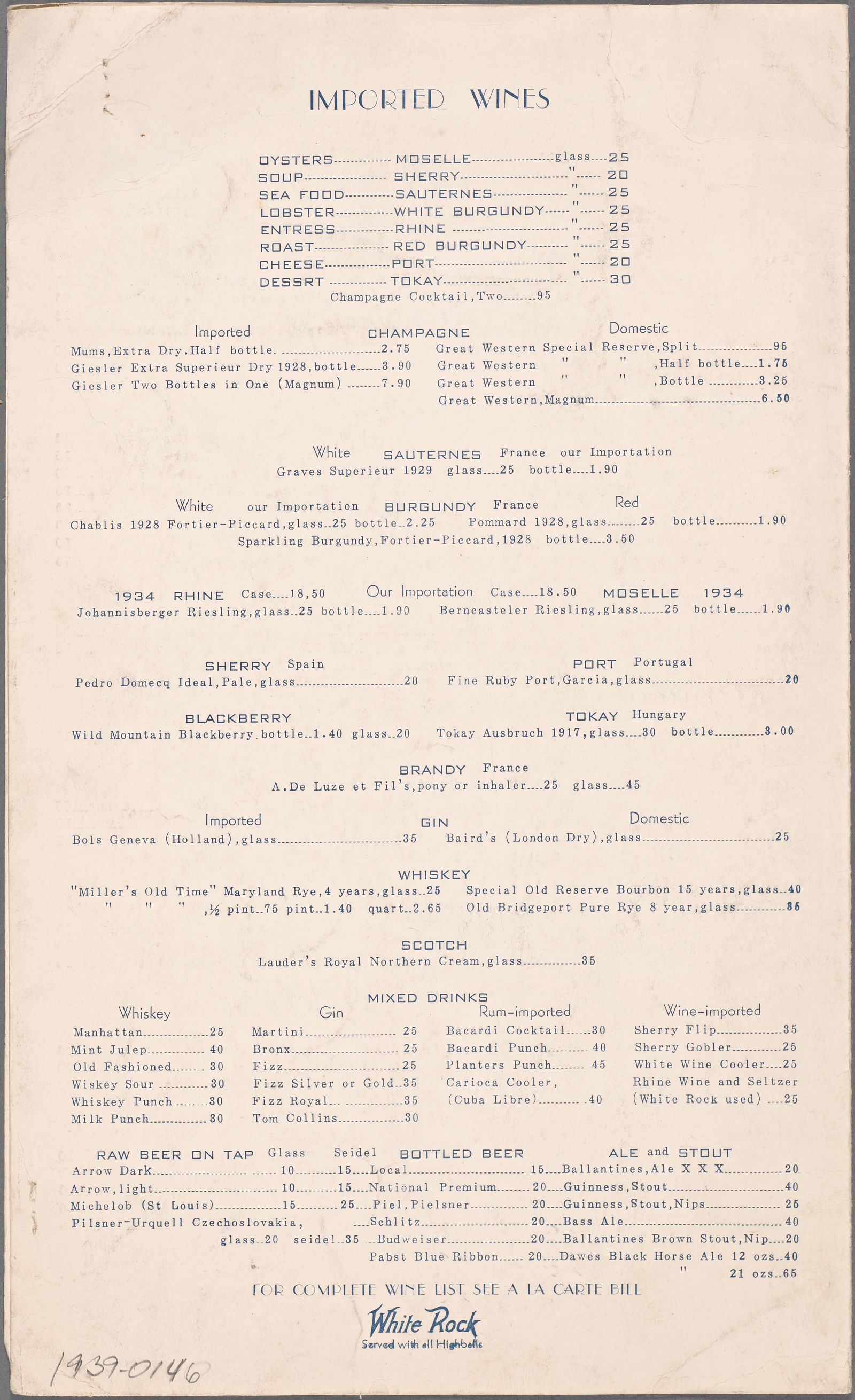
A separate menu helps put those wine styles back on the table. Miller Bros., at 119 West Fayette Street in Baltimore, issued its “Bill of Excellent Fare” for Tuesday, June 20, 1939. Preserved in the New York Public Library’s menu collection and accessible through The Menu Museum, it includes a remarkably practical guide to ordering wine.
The wine page pairs oysters with Moselle, seafood with Sauternes, and roast with red Burgundy, each at 25 cents a glass. Three more suggestions are especially easy to imagine at dinner:
Course | Suggested wine | Price per glass |
|---|---|---|
Soup | Sherry | $0.20 |
Lobster | White Burgundy | $0.25 |
Cheese | Port | $0.20 |
Dessert called for Tokay at 30 cents a glass. Farther down the page, a 1917 Tokay Ausbruch from Hungary appears at $3 a bottle. A 1928 sparkling Burgundy from Fortier-Piccard was $3.50. These are the menu’s original dollar prices, without an adjustment for inflation.
What I like about this page is how directly it connects a wine to a meal. There is no need to invent a grand occasion. You can picture someone choosing the lobster, glancing at the wine suggestions and ordering a glass.
The Baltimore menu and the Ohio cellar are separate pieces of evidence. Together, they give us two ways into the question: what someone kept, and what a restaurant offered to pour. The next time you come across an old menu, spend a little time with the wine list. You may find yourself planning dinner.
Sources and image credit
Cellar reporting: Aaron Goldfarb, “A Wine Cellar Was Left Untouched Since 1939. Here’s What Was Found,” VinePair, October 28, 2026. Bottle names, vintages and counts above follow that report.
Menu and image: Miller Bros., Baltimore, June 20, 1939, wine-list page (image 3997520). From The New York Public Library; scan accessed via The Menu Museum. NYPL catalog record · Open the full-size wine list. The menu illustrates restaurant choices in 1939; it is not a document from the Ohio cellar.
Favorites are saved in this browser on this device.